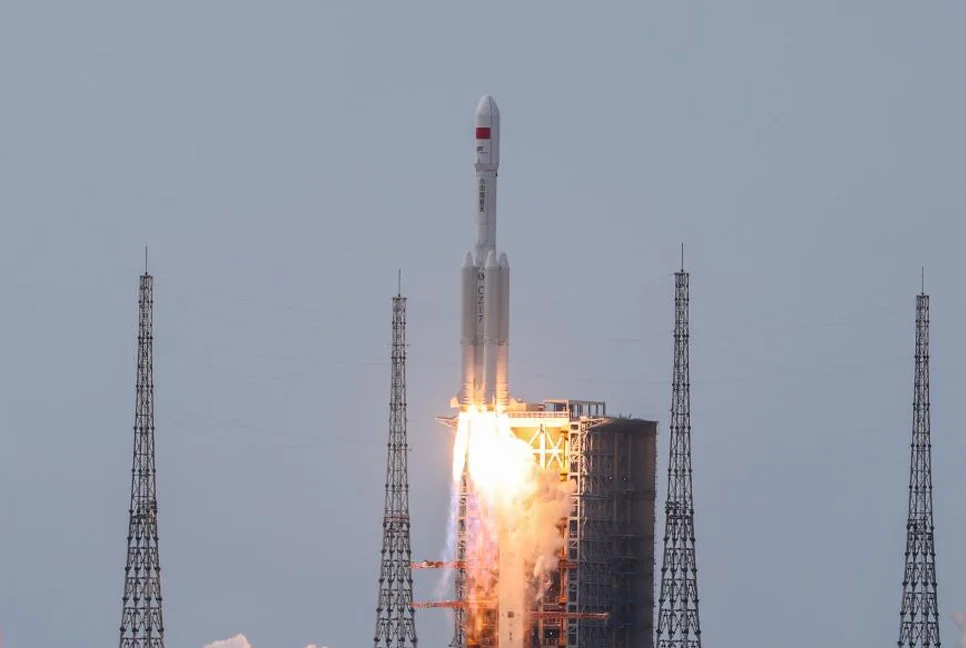
The spacecraft lifted off on Monday morning aboard a Long March 7 rocket from the Wenchang Spacecraft Launch Site in south China’s Hainan Province.
According to the China Manned Space Agency, the rocket blasted into the sky at exactly 8:14 a. m. Beijing time, marking another important step in China’s rapidly growing space programme.
About 10 minutes after launch, Tianzhou-10 successfully separated from the rocket and entered its planned orbit. Moments later, its solar panels unfolded smoothly, confirming that the mission had begun successfully.
The cargo spacecraft is expected to carry out an automated rendezvous and docking operation with the Tiangong space station in orbit.
Officials said Tianzhou-10 is transporting a wide range of essential supplies for astronauts currently working aboard the space station. The cargo includes food, daily consumables, fuel, scientific experiment materials, and one new extravehicular spacesuit for spacewalk activities.
The mission highlights China’s continued push to strengthen its long-term human space exploration efforts and maintain regular operations aboard its independently built space station.
This latest journey is the fifth cargo resupply mission since the Tiangong space station entered its operational and development phase. It also marks the 641st mission in the history of the Long March rocket series, one of the world’s most active launch systems.
Over the past few years, China has expanded its presence in space with a series of successful missions involving astronauts, lunar exploration, and advanced scientific experiments. The Tiangong space station has become a major symbol of the country’s ambitions in modern space technology.
With Tianzhou-10 now safely in orbit, attention will shift to its docking operation and the delivery of supplies that will support future scientific research and astronaut missions aboard the station.
Source: Xinhua News Agency